
Hinduism is the world's oldest living religion. Supposedly, it was brought to the Indian Subcontinent by Aryan invaders. Perhaps it is even older than that, perhaps it started in the Harappan Civilization. Either way, there is no single founder and the religion is between 5,000 -10,000 years old!
Even though there are may gods and goddesses associated with Hinduism, it is a monotheistic religion. Confusing, right? So, how is that so? Hinduism is considered a monotheistic religion because all of these different gods are just ways to help people undertand the one higher power.

Every religion has main texts. Hinduism's main text is The Vedas. The Vedas are split into four books. We will discuss the Upanishads, or the religious texts that explains the Hindu's moral code.
If you follow the moral code, you can be considered a Hindu. That means that a Hindu can also be a Buddhist, a Christian, a Muslim or a Jew. Being a Hindu does not exclude you from following other religions.
The four main parts of the moral code are: Dharma, Karma, Kama, and Moksha.

- Since you are too young to truly have responsibilities from birth through the age of 5, Dharma starts at age 5, with Balavstha, or "Child Time." Your child time is from the age of 5-25. Your primary responsibility: to gain knowledge. This means that other issues should not get in the way of your studies. Your focus should be school: elementary, middle and junior high, high school, college, graduate school.
- Next comes "Married Life." This is from age 25-50. This is the time that you enjoy life. This enjoyment of life is called kama. You settle down, have a family, and just enjoy the gift that is life.
- Next comes "Senior." This is from age 50-75. At this point, you are a mentor. You help others. You also begin detachment from worldly possessions. We often see people in our society mentoring and volunteering more as they get older. They have knowledge and experience that is helpful to others. Also, we all have objects, possessions, that we do not need and when we die, we can not take them with us. So, at this point in life, we should give them to those who can make use of them.
- The last stage of life is Sanyasi, or "Hermit." This is from the age of 75 - death. At this point a person might choose to leave home to meditate. This is when they would focus on their mind on the higher being. This intense single-mindedness would keep their mind from focusing on bodily needs, such as hunger, thirst, cold, etc. Eventually, the person would perish in this stage. Most Hindus do not fulfill this last stage of dharma.

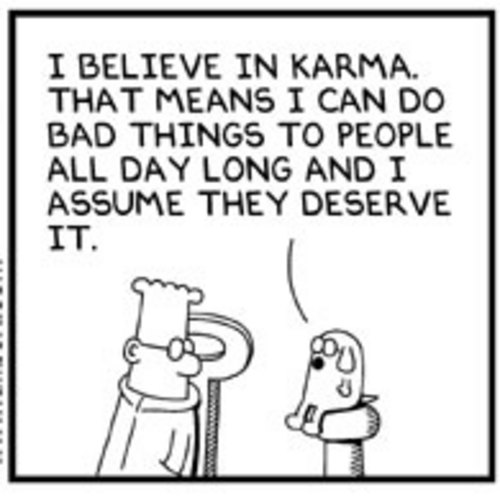 |
| Sorry, Dogbert. It doesn't work that way. |
We have all heard of karma. Simply put, it states that all actions have a reaction. These consequences may be good or they may be bad. Karma reminds you to be mindful in the things that you do. Sometimes children do something and when asked why they did it, the response is: "I don't know." If you do not know why you are doing something, then you should just to not do it. Karma reminds us to always ask: "What are the consequences of my actions?"
Kama: The pleasure of living (within the limits of Dharma and Karma)
Life is a gift. We should enjoy it. But Kama does not allow us to just do whatever we want. It doesn't say that we can start daydreaming in class or stay up all night watching movies. What is the consequence of daydreaming? Perhaps it is that we don't know what an assignment is. That's Karma! And, if our focus is gaining knowledge, then we are not following Dharma. What is the consequence of staying up all night watching movies? Perhaps it is that we miss school and miss out on learning and socializing with our friends. This violates Dharma and produces negative Karma.
Moksha: Salvation or Spiritual Liberation
 |
| A perfect example of what not to do! |
- Knowledge: You can gain salvation through disciplined study of the Vedas, ethical training and meditation. But historically, those in India have been illiterate, and so this path has not been available to the majority of Hindus.
- Good deeds: You can gain salvation through the selfless performance of Dharma. This means that you are fulfilling your duties because it is the right thing to do, and not for any reward. In order to gain spiritual liberation through good deeds, you must be unattached to the outcome. So, if I was to donate my time and money to curing cancer, that would be a good deed. But, if I am doing it partially because people will see my name on a donor's list and I want people to know that I am donating my time and money to the cause, then this is self serving. In this instance, I am attached to the outcome and it doesn't truly count as a good deed.
- Devotion: complete surrender to the higher power. This is the goal of the Hermit stage of life. It is the most difficult to obtain.
Take a look at the map below:

Our symbol for Buddhism is a hot pink. Very little of the map is actually this color. This means that there are few places in the world where the majority of people practice Hinduism. But, in India, most people are Hindus.
Since India is the 2nd most populous country in the world,
Hinduism is still the 3rd largest religion,
with 950 million followers!
Sources:
A very special thanks to Veejay Parashar. After being told by her son that the text had it all wrong, she graciously answered my questions and set me straight on the main tenets of Hinduism. It is from that conversation (and a little further research) that I teach from.
http://www.religioustolerance.org/hinduism.htm
http://www.sanskrit.org/www/Hindu%20Primer/dharma.html
Pictures:
http://www.p12.nysed.gov/ciai/socst/grade3/geoimages/Image12.gif
http://wallpapers-junction.com/Images/Hindu_Gods.jpg
http://whmscomputerlab.wikispaces.com/file/view/vedas.jpg/126846943/vedas.jpg
http://dadsprimalscream.files.wordpress.com/2011/09/karma-large-msg-11401312842-2.jpg
http://school.discoveryeducation.com/clipart/clip/student1.html
http://www.co.campbell.va.us/depts/yacs/PublishingImages/sc_img1.jpg
http://upload.wikimedia.org/wikipedia/commons/thumb/3/33/Bundeswehr_G36.jpg/250px-Bundeswehr_G36.jpg
http://www.learnnc.org/lp/media/collections/freeman/thai_ramayana/600/thai_rama_039.jpg
http://www.cartoonstock.com/newscartoons/cartoonists/pfi/lowres/pfin130l.jpg
