 |
| Battle of the Pyramids by Antoine-Jean Gros |
In 1798, Napoleon Bonaparte's men landed in Egypt. The military goal of the Egyptian campaign was to gain French domination in the east by capturing Egypt and Syria and disrupt England's trade routes.
 |
| The hall of the Institute of Egypt in Cairo, Egypt |
Housed in several palaces in Cairo, they studied matters of engineering, geology, botany, zoology, and more. It was made clear to all French soldiers that their eyes should be out for any curiosities of ancient Egypt.
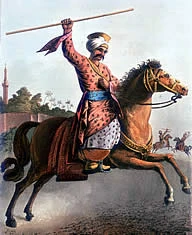 A great discovery was made while the French were digging in, protecting their weakening hold on Egypt from attack by the British, the Ottomans, and the Egyptian Mamluk cavalry.
It was in Rosetta, Egypt that while a group of soldiers, under the command of Major Francois-Xavier Bouchard, were demolishing the city wall. Built into the wall was a black stone. Bouchard recognized that this stone might make it possible to decipher hieroglyphs. And so the stone was carefully dug out and sent to the Institute.
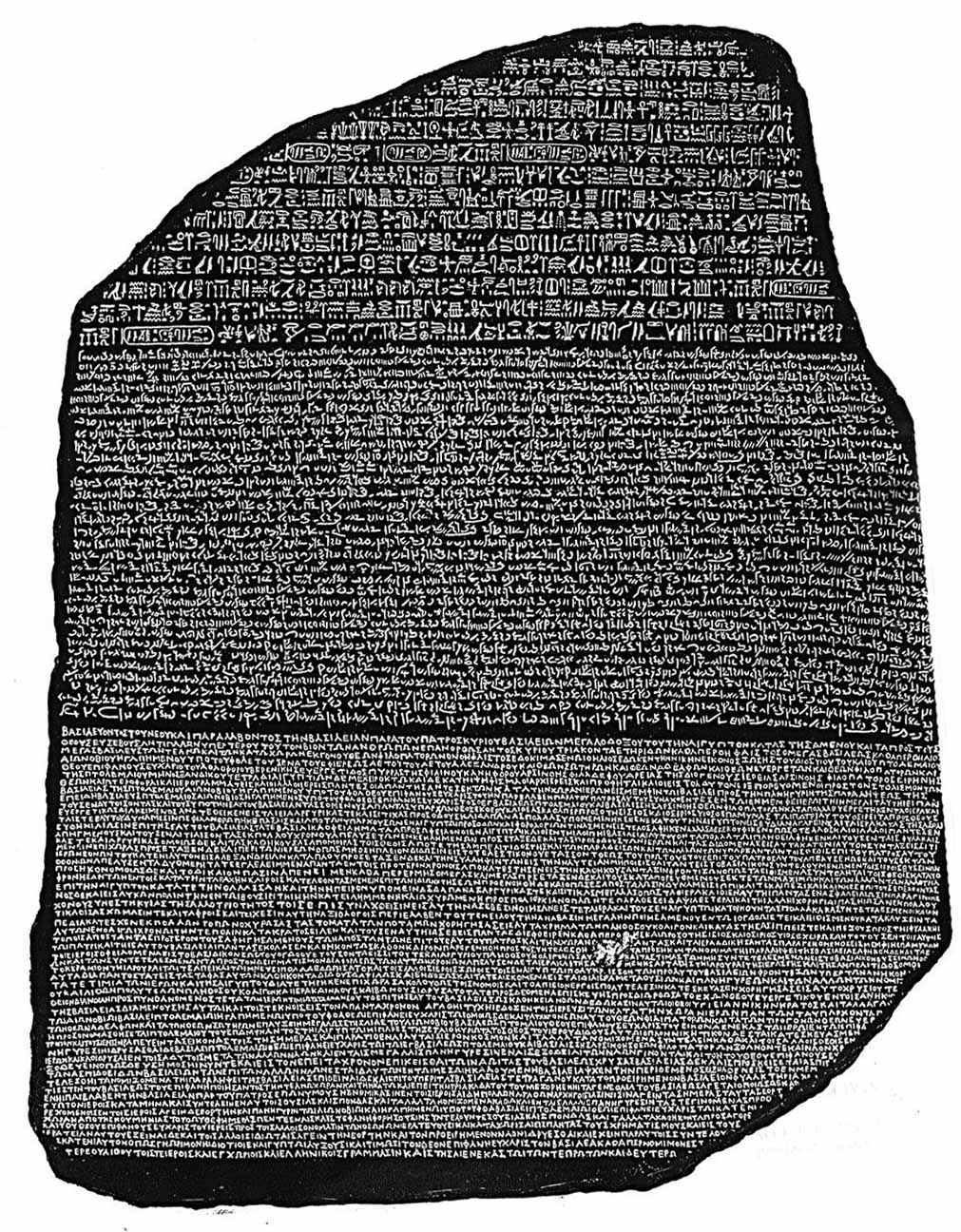
With the black stone was in the scientists hands, it was immediately known that it was the most important object in their possession. The scholars saw, like Bouchard, that the stone was bilingual. At the top were hieroglyphs. In the middle was an unknown language and at the bottom was Greek.
At first it had seemed a simple matter. The stone was trilingual. There were three languages on the stone that said the exact same thing. It would stand to reason that if one of the languages could be read, then so could the other two. And as luck would have it, the third language on the stone was Greek. And, of course, all of the scientists at the Institute of Egypt could read Greek. But for some reason, they still could not read the hieroglyphs
The men at the Institute went to the task of making a print of what came to be known as the Rosetta Stone. Using a few different methods, the stone was essentially used as a writing block. In this way, copies of the stone were sent back to France and on to other countries rather quickly. By the time that engravings of the Rosetta Stone were published in the Description de l'Egypte in 1822 (the books that were published of the findings of the Institute of Egypt), scholars had already spent years using the Rosetta Stone to try translate hieroglphyics.

 |
| A selection from Champollion's notebook |
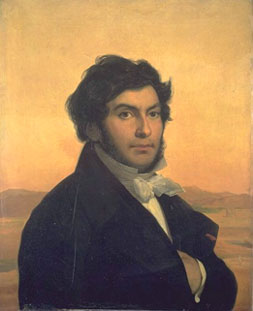 A young Frenchman, Jean-Francois Champollion, had been feverishly working to translate the lost language. He worked with the engraving of the Rosetta Stone and well as rubbings of other sets of hieroglyphs. He also collected cartouche, which were known to contain the names of Egypt's kings and queens.
In 1822, he discovered that Ptolemy's name appeared 5 times in the Greek section and that there were also 5 identical cartouche in the section of hieroglyphs.

He recognized five of the symbols in another cartouche. Filling in the signs he recognized and leaving space s for unknown hieroglpohs, the new cartouche read:
- L E O P - T - -
This obviously was the Egyptian queen Cleopatra. Champollion filled in the spaces.

(Ancient Egyptian had no C)
Had this been all there was to deciphering hieroglyphs, then the job would have been accomplished years earlier, but Champollion was to discover that not only did hieroglyphs include an alphabet of 24 letters, but also had hundreds of other symbols. For hieroglyphs also includes a syllabary (symbols for syllables) and pictographs (symbols for whole words).

What two things were needed to translate hieroglyphs?
2. Cartouche
(and the ingenuity of someone like Jean Francois Champollion!)
Cool Websites:
http://www.britishmuseum.org/explore/highlights/highlight_objects/aes/t/the_rosetta_stone.aspx
http://www.penn.museum/sites/egypt/writing.shtmlSources:
http://www.lindahall.org/events_exhib/exhibit/exhibits/napoleon/
http://www.pbs.org/empires/napoleon/n_war/campaign/page_3.html
http://upload.wikimedia.org/wikipedia/commons/thumb/9/99/Baron_Antoine-Jean_Gros-Battle_Pyramids_1810.jpg/300px-Baron_Antoine-Jean_Gros-Battle_Pyramids_1810.jpg
http://www.bmj.com/content/327/7429/1461/F3.large.jpg
http://cojs.org/cojswiki/images/b/b9/Ptol_Mys.jpg
http://liology.files.wordpress.com/2010/01/rosetta-stone.jpeg
http://www.nndb.com/people/863/000104551/champollion-1-sized.jpg
http://images.wikia.com/deadliestfiction/images/2/20/Mamluk.jpg
http://webhost.bridgew.edu/moore/champollion%20book.jpg
http://library.thinkquest.org/10005/media/photos/RosettaStone.gif
http://www.touregypt.net/images/touregypt/photo1.jpg
